Here is the formatted content converted to clean, structured rich text (Markdown) with all LaTeX math markups removed and replaced with standard text.
---
# Chapter 5: Internet and Web — Study & Revision Pack
## 📌 Section 1: Definitions (1-Mark Direct Concepts)
* **Computer Network:** An interconnection among two or more computers or computing devices to share data and resources.
* **Node (Host):** Any device connected to a communication network that can receive, create, store, or send data (e.g., computers, printers, routers).
* **Ethernet:** A set of standardized rules/protocols that determine how computers and devices connect and communicate via cables in a local network.
* **Modem:** A device that converts digital signals into analog signals (Modulation) at the sender's end and analog signals back into digital bits (Demodulation) at the receiver's end.
* **MAC Address:** A unique hardware address assigned to a Network Interface Card (NIC) to uniquely identify a device on a network.
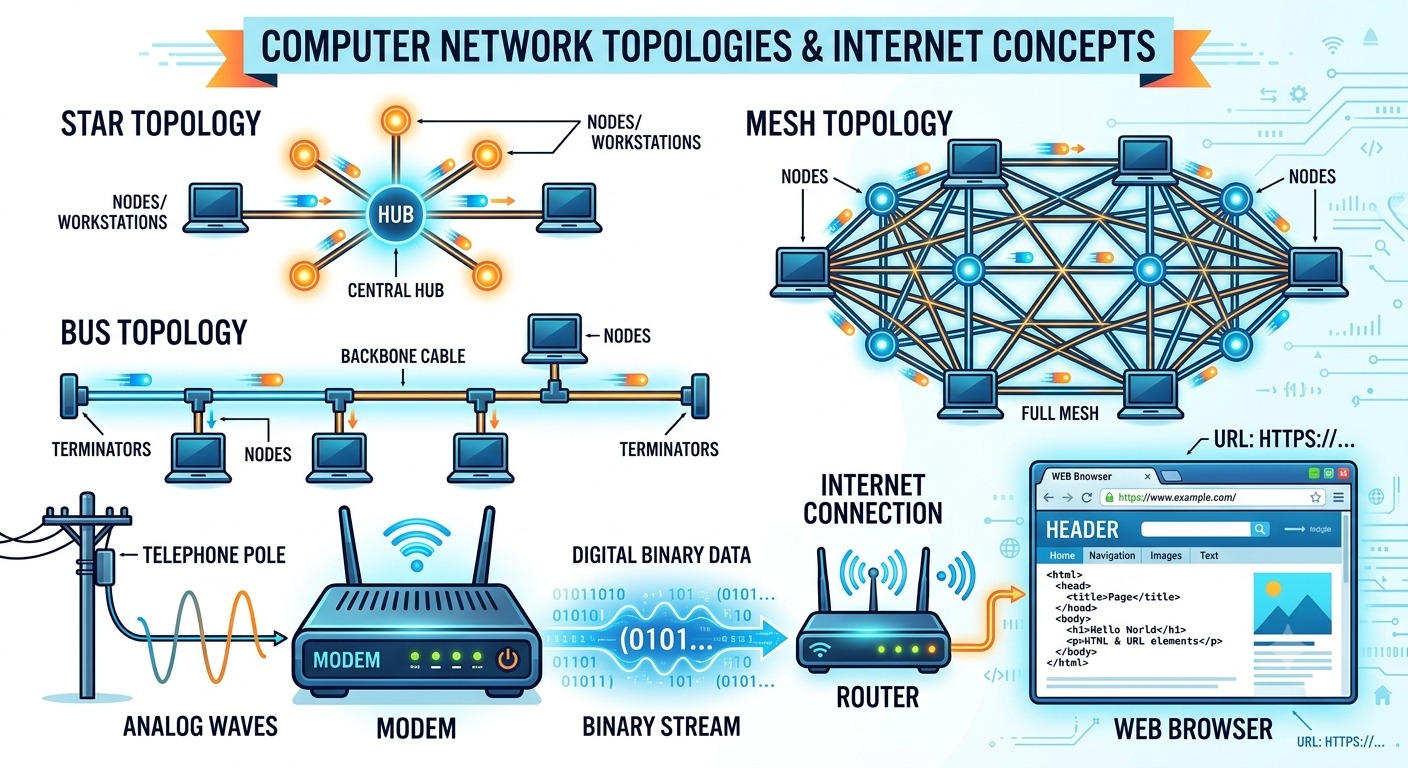
* **Network Topology:** The physical or logical arrangement/layout of computers, cables, and peripherals in a network.
* **URL (Uniform Resource Locator):** A standard naming convention and web address that provides the exact location and access protocol for a resource on the World Wide Web.
* **Web Server:** A computer hardware or software system that stores website files and delivers them to client browsers upon HTTP requests.
* **Dynamic Web Page:** A web page whose content changes dynamically based on user interaction, database updates, or time-specific data.
* **Cookie:** A small text file saved on a user's browser by a website to store preferences, browsing history, and login sessions.
---
## 📝 Section 2: Short Notes (2 to 3 Marks)
### 1. Types of Networks (LAN vs. MAN vs. WAN)
* **LAN (Local Area Network):** Connects devices within a limited distance (up to 1 km) like a room, office building, or campus. Offers high data transfer speeds (10 Mbps to 1000 Mbps).
* **MAN (Metropolitan Area Network):** Covers a larger geographical area such as an entire city or town (extended up to 30–40 km). *Example:* Cable TV networks.
* **WAN (Wide Area Network):** Spans across cities, countries, or continents. The **Internet** is the largest example of a WAN.
### 2. Difference Between Hub and Switch
* **Hub:** A basic networking device that broadcasts incoming data to **all** connected ports, causing network congestion and data collisions.
* **Switch:** An intelligent device that inspects the destination address of arriving packets and forwards them **only** to the intended target device, avoiding collisions and filtering noisy/corrupted signals.
### 3. Router vs. Gateway
* **Router:** Receives, analyzes, and routes data packets between different networks (e.g., LAN to Internet) and can repackage data packets if required by another network.
* **Gateway:** Acts as an entry and exit point ("gate") between an organization's internal network and an external network. It handles protocol conversions and often integrates security firewalls.
### 4. World Wide Web (WWW) vs. Internet
* **Internet:** The physical, global infrastructure of interconnected computer networks, cables, routers, and devices.
* **WWW:** An information retrieval service operating **on top of** the Internet consisting of interlinked web pages and digital resources accessed via URLs and HTTP.
### 5. Static vs. Dynamic Web Pages
* **Static Web Pages:** Written in HTML/CSS/JavaScript with `.htm` or `.html` extensions. Content remains identical for every user and requires no server-side processing or database connection.
* **Dynamic Web Pages:** Created using server-side languages (Python, PHP, Java, ASP.NET). Content is retrieved from databases in real-time and generated uniquely for different users or actions (e.g., banking portals, weather sites).
### 6. Add-ons vs. Plug-ins
* **Plug-in:** A complete, standalone software program installed on the host computer that can be utilized by browsers and other applications (e.g., Adobe Flash Player, Java).
* **Add-on (Extension):** A lightweight module specifically designed to extend or modify functionalities directly within a web browser.
---
## ✏️ Section 3: Fill in the Blanks
1. For communication over a network, data is divided into smaller chunks called **packets**.
2. The set of rules that decides how computers connect through cables in a LAN is called **Ethernet**.
3. The device that regenerates weakened signals traveling beyond 100 meters is a **Repeater**.
4. To build a fully-connected mesh topology of *n* nodes, **n(n - 1) / 2** wires are required.
5. The hierarchical network arrangement composed of star and bus sub-networks is called **Tree (or Hybrid)** topology.
6. **Sir Tim Berners-Lee** invented the World Wide Web in 1990.
7. The protocol that securely retrieves linked web pages across the web is **HTTPS**.
8. The error code displayed by a web browser when a server cannot locate a requested page is **Error 404**.
9. The mapping between domain names and IP addresses on the Internet is managed by **DNS (Domain Name System)**.
10. **Mosaic** was the first web browser developed by the NCSA.
---
## 🔘 Section 4: True or False
1. **False:** A hub transmits data packets selectively only to the destination machine. *(Correction: A hub broadcasts data to all connected ports.)*
2. **True:** Data transfer link in a ring topology is unidirectional.
3. **True:** A router can repackage larger data packets into smaller ones if required by the receiving network.
4. **False:** In bus topology, if the central node fails, only one device gets disconnected. *(Correction: Star topology relies on a central node; in bus topology, a failure in the backbone cable brings down the whole network.)*
5. **True:** VoIP converts analog voice signals into digital data packets for transmission over broadband lines.
6. **False:** HTML is used to perform complex server-side operations and retrieve data from databases. *(Correction: HTML designs the basic structure of a web page; server-side languages handle database retrieval.)*
7. **True:** Modern web routers at home often perform the combined tasks of a router, switch, and modem.
8. **False:** Cookies are executable programs that run malware on the user's hard drive. *(Correction: Cookies are plain text files stored by browsers to remember settings and user preferences.)*
---
## 🎓 Section 5: CBSE Board Exam Pattern Questions
### Section A: Multiple Choice Questions (1 Mark Each)
**Q1. Which device is used to convert digital signals from a computer into analog signals for transmission over telephone lines?**
* (A) Switch
* (B) Repeater
* (C) Modem
* (D) Gateway
**Answer:** **(C) Modem**
---
**Q2. Which topology requires every node to be connected directly to every other node in the network?**
* (A) Star
* (B) Bus
* (C) Tree
* (D) Mesh
**Answer:** **(D) Mesh**
---
**Q3. Which of the following is an application of VoIP technology?**
* (A) Email
* (B) Internet Telephony
* (C) Web Hosting
* (D) Static Web Page
**Answer:** **(B) Internet Telephony**
---
**Q4. What is the full form of URL?**
* (A) Unified Resource Locator
* (B) Uniform Resource Locator
* (C) Universal Resource Link
* (D) Uniform Real-time Link
**Answer:** **(B) Uniform Resource Locator**
---
### Section B: Short Answer Questions (2 Marks Each)
**Q5. What is an e-mail attachment? Mention one advantage of using attachments.**
> **Answer:**
> An email attachment is a pre-existing file (text document, image, audio, or video) stored on secondary storage that is sent alongside an email message.
> **Advantage:** It eliminates the need to retype or recreate existing document content inside the mail body, allowing quick file transfer across the globe.
---
**Q6. Define VoIP. Mention one advantage and one disadvantage of using VoIP services.**
> **Answer:**
> **VoIP (Voice over Internet Protocol)** is a technology that allows voice calls (telephone calls) to be transmitted over digital IP networks/Internet instead of traditional telephone networks.
> * **Advantage:** Highly economical or free, enabling low-cost international calling.
> * **Disadvantage:** Call quality depends entirely on Internet speed; a slow connection causes poor voice quality.
>
>
---
### Section C: Case/Application Based Question (3 Marks)
**Q7. Joe opened his web browser and typed `[http://www.ncert.nic.in/textbook/textbook.htm](http://www.ncert.nic.in/textbook/textbook.htm)`.**
*(a) Identify the protocol and the domain name from the above URL.*
*(b) Joe encountered an Error 404 screen. What does this error signify?*
> **Answer:**
> **(a)**
> * **Protocol:** `http` (or HyperText Transfer Protocol)
> * **Domain Name:** `ncert.nic.in`
>
>
> **(b) Error 404:** Signifies that the requested web page could not be located on the web server (either the file was moved/deleted or the web address/file path was typed incorrectly).
---
### Section E: Case-Study / Comprehensive Network Installation (5 Marks)
**Q8. ABC Pvt. Ltd. is setting up a new campus with four main wings: Administration, Sales, Development, and Support.**
**Distances:**
* Admin to Sales: 60 m
* Admin to Development: 90 m
* Admin to Support: 120 m
* Sales to Support: 70 m
* Development to Support: 45 m
**Number of Computers:**
* Admin: 120
* Sales: 40
* Development: 70
* Support: 25
*(i) Suggest the most suitable wing to place the Server. Justify your answer.*
*(ii) Suggest a suitable cable layout to connect all four wings efficiently.*
*(iii) Which hardware device should be installed inside each wing to connect all local computers together?*
*(iv) If the company wants to connect this office in Mumbai with their regional office in Jaipur (1400 km away), which type of network (LAN, MAN, WAN) will be formed?*
*(v) Signals weaken when transmitted from Admin to Support (120 m). Which device should be installed to regenerate signals?*
> **Answer:**
> **(i) Server Location:** **Administration Wing**, because it contains the maximum number of computers (120 machines), following the 80/20 rule to minimize network traffic.
> **(ii) Cable Layout:** **Star Topology** connecting Admin to all other wings:
> * Admin → Sales (60 m)
> * Admin → Development (90 m)
> * Admin → Support (120 m)
>
>
> **(iii) Hardware Device:** **Switch** (or Hub) in each wing.
> **(iv) Network Type:** **WAN (Wide Area Network)**.
> **(v) Signal Regeneration Device:** **Repeater** (since the distance exceeds 100 meters).