Choosing the best play school in India can feel like a lifelong decision made in a single afternoon. It isn’t. Your child simply needs a safe, warm place to play, learn and make friends. This guide covers the right age to start, how play school differs from nursery, and a simple 10-point checklist you can use to build your own shortlist.
Disclosure: this guide is published by Thames Valley Preschool, a preschool brand. The advice works for any school, including ours.
How do you choose the best play school in India?
Choose the play school that is safe, warm and play-based, with trained teachers, a clear daily routine, fees in writing and a trip from home that your child can handle. There is no single best play school for every family.
You’ll have to do some of the checking yourself. Private preschools are largely unregulated at the national level, and rules differ by state. So the three habits that matter most are simple: visit in person, ask specific questions and book a trial day.
What is the difference between a play school, nursery and preschool?
In India, these words overlap, and schools use them in different ways. Always ask what each class means at the school you’re visiting.
Term Usual age What it usually involves
Play school or playgroup About 1.5 to 3 years Short sessions, play, songs and getting used to time away from parents
Nursery About 3 years The first formal preschool class, with stories, art and early language and numbers through play
LKG About 4 years A little more structure, and early reading and number readiness through activities
UKG About 5 years Getting ready for Class 1
These ages are typical, not rules. “Preschool” is the umbrella word for all of these years.
How do you know the right age to start preschool?
Many children start play school between about 2 and 3 years and nursery at around 3. The right age is when your child can cope with a few hours away from you, not a number on a calendar.
India’s National Education Policy (NEP) 2020 counts ages 3 to 6 as the preschool years, followed by Classes 1 and 2. Class 1 begins at age 6. So a child who starts nursery at 3 moves through nursery, LKG and UKG and reaches Class 1 at 6.
Signs your child may be ready:
• They can stay with a familiar adult for a short time without you
• They show interest in other children
• They can tell you what they need, even in a few words
• They have some rhythm to sleep and meals
Not every child ticks every box, and that’s fine. If your child isn’t ready, waiting a few months or starting with shorter days is a sensible choice. Don’t rush because a neighbour’s child already started. Age cut-offs and toilet-training expectations differ by school and state, so check each school’s current rules.
How do you find the best nursery preschool in India?
Start from your daily route, not from an online list. Then follow five steps.
1. Shortlist three to five schools within a sensible travel time. Test the route at real drop-off time on a weekday.
2. Ask for the full-year fee in writing. Include tuition, admission fee, annual fee, transport, uniform, books and meals.
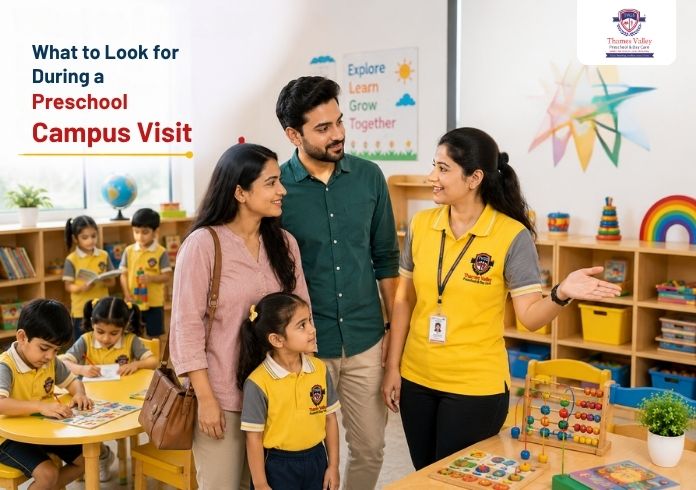
3. Visit while classes are running. Watch how teachers talk to children, and whether the children look relaxed.
4. Ask about the daily routine and the number of children per adult. Fewer children per adult is better.
5. Book a trial day. You’ll learn more in one morning than from any brochure.
How do you choose from the top 10 play schools in India?
Don’t look for a ready-made list of ten school names. Build your own top 10 checklist and score every school against it.
Why? There’s no official national ranking of play schools. Many online “top 10” lists are written by the schools themselves, and what counts as top in Delhi may not exist in your town. Your own scorecard is more honest than any list.
Score each school out of 10 on these points, then compare the totals:
6. Safety: secure entry, clear pick-up rules and verified staff
7. Hygiene: clean, child-sized washrooms and clean play areas
8. Teachers: warmth, patience and early-childhood training
9. Adult-to-child ratio: how many children each adult looks after
10. Daily routine: a healthy mix of play, stories, rest and learning
11. Space: a safe outdoor or indoor area for active play
12. Communication: regular updates and an easy way to raise concerns
13. Fees: a clear, written, full-year cost
14. Distance: a commute your child can manage every day
15. Settling in: a trial day and a gentle plan for children who cry
A school that fails on safety is out, whatever its total. After that, the highest score usually points to the right fit.
What are the red flags?
• Pressure to pay the same day
• Writing drills or formal tests for three-year-olds
• No trial day and no classroom visit
• Vague answers about fees
• Teachers who seem to change every few months
• Reluctance to show you the washrooms or play area
Where does Thames Valley Preschool fit in?
Thames Valley Preschool is a preschool brand that also offers franchise opportunities. If you’re a parent, use the checklist above on any centre near you, ours included. If you’re thinking about starting a centre of your own, you can explore Thames Valley franchise opportunities.
Frequently asked questions
What is the best age to start play school in India?
Many children start play school between about 2 and 3 years and nursery at around 3. The best age is when your child can manage a few hours away from you. Age cut-offs differ by school, so check each school’s current rules.
What is the difference between play school and preschool?
Preschool is the umbrella term for the early years before Class 1, usually ages 3 to 6 in India. Play school or playgroup usually refers to the first, gentler stage for younger children, followed by nursery, LKG and UKG. Schools use these terms differently, so ask what each one means.
Is play school necessary for my child?
Play school is a family choice. India’s National Education Policy 2020 treats ages 3 to 6 as important preschool years and recommends play-based learning, but you should check the current rules and decide based on your child’s readiness.
How much does a play school cost in India?
Fees vary widely by city and type of school, so there is no reliable single figure. Ask each school for a written full-year breakup covering tuition, admission, annual fee, transport, uniform, books and meals.
How many play schools should I visit before choosing?
Visit three to five schools on your daily route. That gives you enough to compare without getting overwhelmed. Score each one on the same checklist and book a trial day at your top two.
Can my child join nursery without attending play school?
Many schools allow it, but policies differ. Ask the school what it expects from a child joining nursery directly and how it helps new children settle in.








.png)



.png)

.png)



.png)







.png)


.png)

 NOW.png)
.pdf)

.png)








.png)







.jpeg)

.jpeg)

.png)







.png)
.png)
.png)


.png)






.jpg)


.jpg)