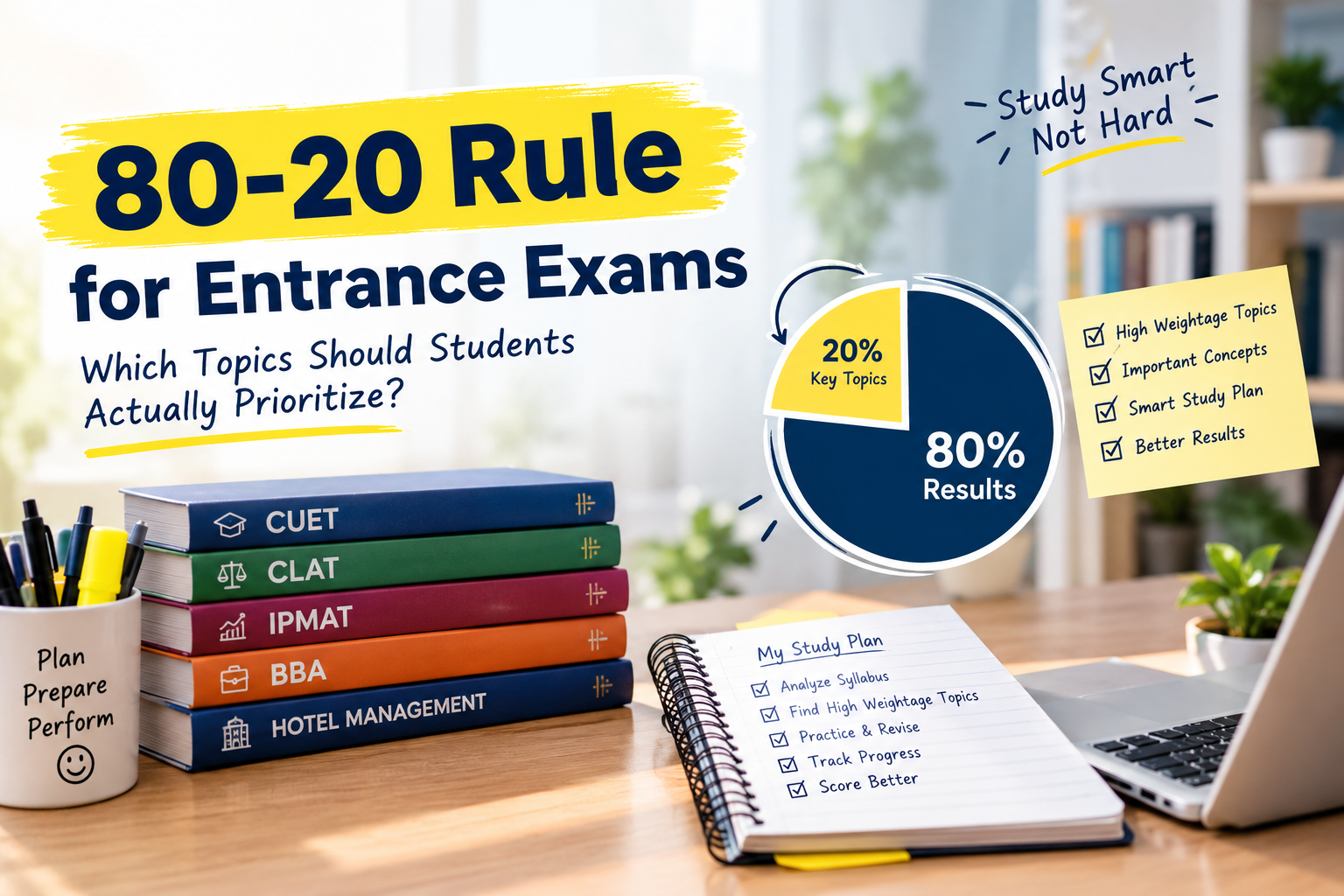
Preparing for an entrance exam can become difficult when the syllabus feels too large and study time is limited. Instead of giving equal time to every chapter, students can follow a smart **Entrance Exam Preparation Strategy** that focuses more on important and high-value areas.
A planned approach helps students use their time efficiently while still maintaining overall syllabus coverage. Whether you are preparing for CUET, CLAT, IPMAT, BBA, Hotel Management, or another competitive entrance exam, knowing what to study first can make your preparation more organized.
## Why You Need an Entrance Exam Preparation Strategy
Many students spend hours studying without having a clear plan. As a result, they may complete several chapters but still struggle with questions in mock tests.
An effective **entrance exam study strategy** helps you identify your strengths, weaknesses, frequently tested concepts, and areas that need additional practice.
Your strategy should consider:
* Previous-year question papers
* Mock-test performance
* Frequently tested concepts
* Section-wise importance
* Your accuracy level
* Time required to prepare each topic
Therefore, instead of simply counting study hours, focus on how effectively those hours are being used.
## How to Prioritize Topics for Entrance Exams
Knowing **how to prioritize topics for entrance exams** is one of the most useful skills for students.
Start by making a complete list of your subjects and chapters. Then divide them into three categories:
**High Priority:** Topics that appear frequently, carry significant importance, or are areas where you need improvement.
**Medium Priority:** Topics that require regular preparation but may not need as much time as high-priority areas.
**Low Priority:** Topics that appear less frequently or can be covered later when your important areas are already prepared.
However, low priority does not mean completely skipping a topic. It simply means managing your preparation time according to importance.
## Finding High Weightage Topics for Entrance Exams
Identifying **high weightage topics for entrance exams** can help you make better use of limited preparation time.
Previous-year papers are a useful starting point. Look for concepts and question types that appear repeatedly. In addition, mock tests can show which topics are commonly tested and where you are losing marks.
However, students should avoid assuming that previous trends guarantee future questions. Exam patterns can change. Therefore, use trends as a guide while maintaining reasonable coverage of the complete syllabus.
## Important Topics for Entrance Exams Depend on the Exam
The **important topics for entrance exams** vary according to the examination.
For example, CUET preparation may require attention to language, general aptitude, and relevant domain subjects. CLAT requires preparation across areas such as reading comprehension, logical reasoning, legal reasoning, current affairs, and quantitative techniques.
Similarly, IPMAT preparation requires attention to quantitative ability and verbal ability, along with the specific requirements of the examination.
Therefore, students should first understand their exam pattern and syllabus before creating a preparation schedule.
## Create an Entrance Exam Preparation Plan
A practical **entrance exam preparation plan** should divide your available time according to priority.
For example, if you have three hours available for preparation, you could use:
* 90 minutes for high-priority topics
* 45 minutes for question practice
* 30 minutes for revision
* 15 minutes for error analysis
This is only a basic example. Your schedule should change according to your exam, preparation level, strengths, and weaknesses.
Moreover, keep some time for revision every day. Regular revision helps you retain concepts and identify topics that need additional practice.
## Entrance Exam Preparation Tips for Better Results
Along with planning, students should follow practical **entrance exam preparation tips**.
First, avoid spending several days on one extremely difficult topic while ignoring easier scoring areas. Next, do not collect too many books, PDFs, videos, and notes because excessive study material can create confusion.
Also, do not take mock tests only to check your score. Analyse your mistakes after every test and identify why you lost marks.
Most importantly, track your own progress instead of comparing your preparation with other students.
## How Mock Tests Improve Your Study Strategy
Mock tests are an important part of an effective **entrance exam study strategy** because they show how well your preparation works under time pressure.
After completing a mock test, divide your mistakes into categories such as:
* Conceptual mistakes
* Calculation mistakes
* Reading mistakes
* Time-management mistakes
* Guessing mistakes
* Careless mistakes
Then identify repeated patterns.
If you consistently make mistakes in the same topic, move that topic higher on your priority list. Similarly, if you spend too much time on a particular section, include more timed practice in your schedule.
## How to Prepare for Entrance Exams Without Wasting Time
Students often ask **how to prepare for entrance exams** when they have limited time.
The answer is not simply studying for longer hours. Instead, focus on studying the right topics consistently.
Start with your syllabus. Analyse previous-year papers and mock tests. Identify high-priority areas and create a realistic daily schedule. Then practise questions and regularly review your mistakes.
This process allows you to make your preparation more focused without ignoring the rest of the syllabus.
## Use a Balanced Approach
A smart preparation strategy does not mean studying only the top 20% of topics. Instead, it means giving more time and attention to areas that can have a greater impact on your performance.
High-priority topics should receive more practice and revision. Medium-priority topics should receive regular preparation, while low-priority topics can receive basic coverage when time is limited.
As a result, students can prepare strategically while still maintaining balanced syllabus coverage.
## Final Thoughts
A strong **Entrance Exam Preparation Strategy** is about making better decisions with your study time. By analysing previous papers, reviewing mock-test performance, identifying important topics, and creating a realistic schedule, students can make their preparation more organized and effective.
The goal is not to study everything for the same amount of time. Instead, focus more on important areas while continuing regular revision of the remaining syllabus.
With the right **entrance exam preparation tips**, consistent practice, and a clear **entrance exam preparation plan**, students can prepare smarter and approach their entrance exam with greater confidence.